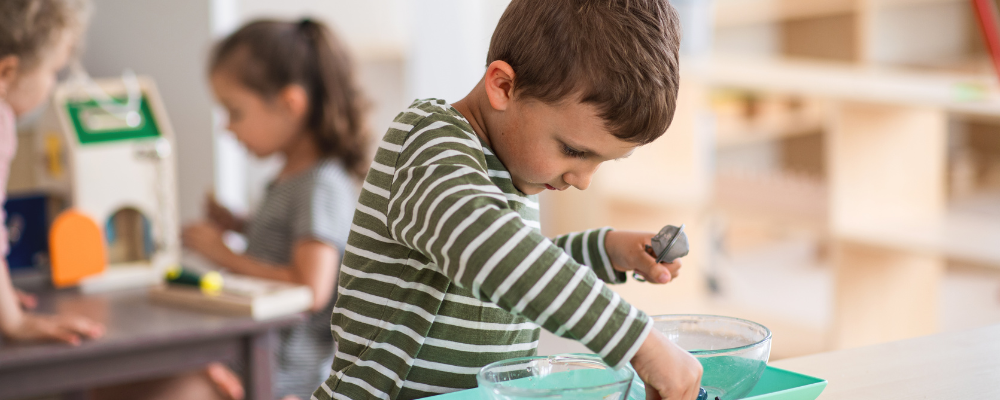
In most traditional schools, children are grouped by age in one-year intervals—3-year-olds in one class, 4-year-olds in another, and so on. But step into a Montessori classroom, and you’ll find something different and beautifully intentional: a mix of ages learning and growing together in the same space.
This is not by accident—it’s by design. Montessori education groups children in multi-age classrooms, typically in 3-year cycles (e.g., ages 3–6, 6–9). But why is this done? And what benefits does it offer?
Let’s explore why mixed-age classrooms are one of the most powerful aspects of the Montessori method.
The Philosophy Behind Mixed-Age Learning
Dr. Maria Montessori believed that children thrive when allowed to learn at their own pace, supported by both younger and older peers. In a mixed-age classroom:
-
Younger children observe and absorb knowledge from older classmates.
-
Older children reinforce their learning by teaching and guiding younger peers.
-
Each child moves forward according to their individual development, not just their age.
This structure mirrors real life—where people of different ages live, work, and collaborate together.
Benefits of Mixed-Age Montessori Classrooms
1. Natural Peer Learning
Children learn a great deal from watching and working with others. Younger students often pick up skills just by observing older children. At the same time, older children reinforce their knowledge by explaining it—turning learning into a two-way street.
“The child who teaches is the child who learns twice.” — Montessori principle
2. Stronger Social Development
Mixed-age classrooms encourage cooperation over competition. Children develop empathy, patience, and leadership by interacting with peers of different ages and abilities.
-
Younger children look up to older ones as role models.
-
Older children build confidence and kindness through mentorship.
This creates a sense of community and belonging—where everyone has a role to play.
3. Customized Learning Pace
In traditional classrooms, children are often expected to keep pace with the group. But in a mixed-age setting:
-
A younger child who is ready can explore more advanced materials.
-
An older child who needs more time can revisit foundational skills without feeling left behind.
Learning becomes personalized, pressure-free, and joyful.
4. Greater Continuity and Stability
Children usually stay in the same classroom with the same teacher for three years. This continuity allows:
-
Teachers to understand each child deeply—academically, emotionally, and socially.
-
A stable environment that builds trust, confidence, and comfort.
Parents often notice their child becoming more independent, secure, and responsible over time.
5. Leadership & Responsibility
By the third year in a Montessori classroom, the oldest children naturally step into leadership roles. They help guide routines, support younger classmates, and model respectful behavior.
These early experiences lay the foundation for lifelong leadership skills and confidence.
How You Can Support It at Home
-
Encourage your child to help a younger sibling or friend with small tasks.
-
Create playgroups that include mixed-age children.
-
Remind your child of the joy in both learning from others and helping others grow.
Final Thoughts
At Orrchid Montessori House, our mixed-age classrooms are vibrant communities of learning, sharing, and discovery. They honor each child’s unique journey while building essential life skills—like collaboration, compassion, and confidence.
When children of different ages grow together, they don’t just learn facts—they learn how to live, lead, and care.
📌 Curious about how our classrooms work?
Visit us to experience the Montessori difference in action.
📞 Contact Us or 📍Come take a tour—we’d love to welcome you!